The New York Times and The Wall Street Journal have run at least 155 ads on branded podcasts since September by the United States oil industry’s biggest lobby group, a DeSmog analysis has found.
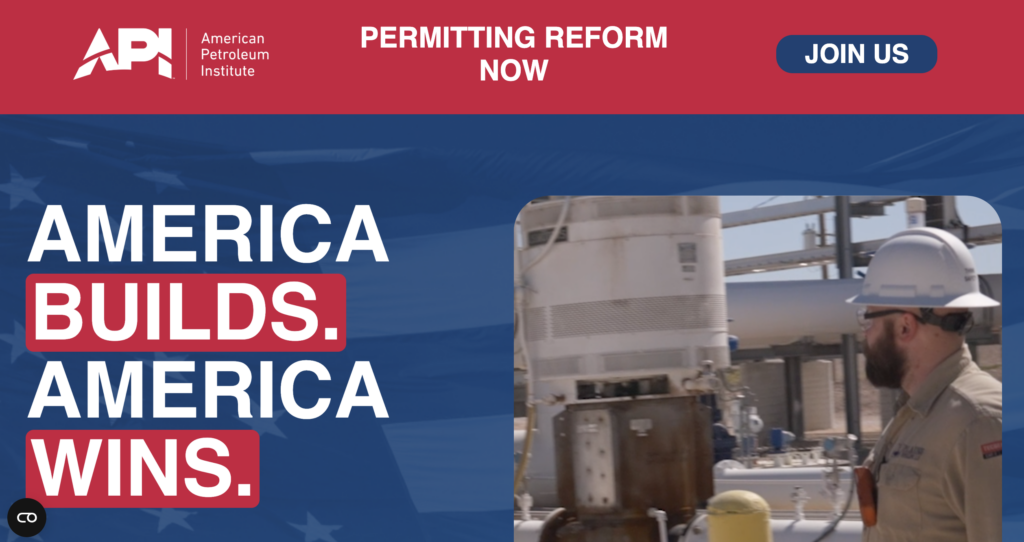
The newspapers’ ads push for weakened laws around fossil fuel infrastructure permits and are part of the American Petroleum Institute’s (API) “When America Builds, America Wins” campaign. The ads call for the government to “overhaul our broken permitting process” because “America’s natural gas and oil keeps the country moving,” mirroring President Donald Trump’s drive to gut environmental laws and increase fossil fuel production.
The campaign included 85 ads in New York Times podcasts over the past nine months, according to data analyzed by DeSmog from market research platform Critical Mention. Nearly three-quarters of these ads appeared in “The Daily,” the third-most-listened-to podcast in the U.S. in the first quarter of 2026, the analysis found.
A further 70 ads appeared on The Wall Street Journal podcast, “WSJ Opinion: Potomac Watch.”
The ads, which most recently ran with one of the two outlets on May 21, lead to an API web page where visitors are encouraged to use a template to write a letter to their local politicians saying they want to see permitting reform.
By accepting oil industry ads calling for oil and gas expansion, legacy media organisations are promoting Trump-aligned policies that undermine international climate goals, experts say.
“When elite news outlets like The New York Times and Wall Street Journal accept sponsorships from these actors, it corrodes the trust their climate reporting depends on,” said Michelle Amazeen, associate dean of research and an associate professor of mass communication at the Boston University College of Communication.
“Just as Big Tobacco spent decades muddying the science about the harms of their products, fossil‑fuel interests now push the line that they’re part of the solution.”
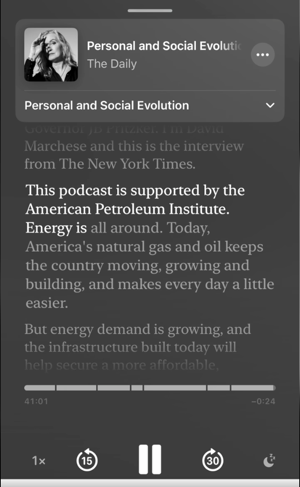
API has sponsored several episodes of “The Daily,” which has covered climate and environmental themes since the campaign launched. On March 7, API ads ran on either side of an interview with renowned environmental writer Rebecca Solnit, during which host David Marchese said the world is “living through […] the ongoing slow motion disaster of the climate crisis,” and Solnit argued, “the fossil fuel industry [is] what’s holding us back.”
API has a long history of running campaigns to deny climate change and delay climate action. Its members include U.S. oil giants such as ExxonMobil and Chevron, the American subsidiaries of UK rivals Shell and BP, and Norway’s Equinor.
Its pro-permitting ads have continued to run steadily since key oil shipping passage the Strait of Hormuz closed following the Trump administration and Israel’s attacks on Iran at the end of February, which sparked fears of global oil shortages.
Many of the world’s most trusted English-language news outlets earn millions of dollars running ads that promote fossil fuel industry talking points, a 2023 DeSmog and Drilled investigation found. These ads often portray fossil fuel production as necessary for energy security — a claim regularly contested by researchers — or oil and gas companies as leaders of the clean energy transition, even as those companies continue to overwhelmingly invest in fossil fuels.
API ads placed in The New York Times and The Wall Street Journal podcasts approached the licensing subject differently than those placed with media followed by the API’s usual, more conservative target audience, the analysis found.
Across the three versions of the ad run on the two outlets’ podcasts, only one made a direct reference to oil and gas, instead referring to “energy” more broadly. The ads described how building new energy infrastructure “will power generations to come” and “deliver affordable, reliable energy.”
A version of the ad that ran 80 times with Fox News-sponsored “Ruthless” — a podcast popular with younger, conservative men — was more direct: “For decades, critical energy projects have been blocked … putting America’s energy dominance at risk. The solution is obvious. Overhaul the broken energy permitting process … Abundant oil and gas.”
“Ruthless” is run by three former Republican staffers, including Josh Holmes, who worked as chief of staff for Kentucky Republican Senator Mitch McConnell from 2010 to 2013. During that time, McConnell repeatedly denied the existence of climate change and pushed to protect Kentucky’s coal industry.
A spokesperson for The New York Times said: “we have ad standards that we apply across all ads, but try not to exclude certain categories or topics that would unintentionally endorse one business model over another. Instead, we help the public seek the truth and understand the world through our coverage.”
“Energy, utility and fossil fuel companies may purchase and run media on The New York Times properties. However, we do not allow oil and gas companies to sponsor our Climate journalism and Climate events or be the sole sponsor for “The Daily.”
A spokesperson from Dow Jones, the company that owns The Wall Street Journal, said: “We accept a wide range of advertisements across hundreds of sectors and industries, including energy organizations spanning both traditional fossil fuels and renewable alternatives.”
“The Wall Street Journal newsroom and its editorial team operate completely independently of our advertising department, ensuring the Journal’s reporting and commentary remain free from outside influence or commercial considerations.”
API and Ruthless did not respond to requests for comment.
API’s Policy Ad Drive
API launched the “When America Builds, America Wins” campaign in September 2025 to push its policy wish list. The policies are designed to make it easier for fossil fuel companies to win and maintain permits for oil and gas projects like pipelines, power plants, and export terminals in the U.S., building on Trump’s existing deregulation programme.
“American energy is ready to go, but Washington’s broken permitting system is standing in the way,” API President and CEO Mike Sommers said in a press release announcing the campaign. “As energy demand rises, critical infrastructure to deliver it is stuck behind red tape. It’s time for Congress to act on durable reforms that ensure access to affordable, reliable, and secure energy — because when America builds, America wins.”
In total, the campaign ran at least 1,000 times on podcasts and radio, according to DeSmog’s analysis. It also featured widely across online platforms including YouTube, Google, Facebook, Instagram, and LinkedIn.
The wish list’s suggested policies include to “prohibit [the] use of the social cost of carbon in reviews” — a way of measuring the socioeconomic damage from planet-heating carbon emissions — and, to limit litigation, to set a 150-day window for lawsuits challenging new oil and gas projects.
The second Trump administration has rolled back dozens of environmental and climate policies since taking office in January 2025.
Under Trump, federal agencies are systematically failing to enforce environmental laws — including the Clean Water Act and others targeted by API — when permitting fossil fuel projects, a lawsuit brought last year by a coalition of Democratic state attorney generals alleges.
The U.S. government is now considering removing certain drilling zone protections, such as the regions surrounding the Chaco Culture National Historical Park in New Mexico, a UNESCO World Heritage Site.
If the protections were removed, the API’s proposals would make it significantly harder to challenge drilling licenses then granted in such areas, which local communities and environmental advocates say threaten highly sensitive ecosystems and culture heritage sites.
Every Ad Company Is ‘Complicit’
U.N. Secretary General António Guterres called for a global fossil fuel ad ban and urged ad agencies to drop fossil fuel clients, saying they were helping to deflect pressure to transition away from oil and gas.
“Every major advertising and PR holding company is complicit,” said Laura Ranzato, director of industry pressure group Clean Creatives. “They hold tens of fossil fuel contracts each, from national campaigns to global accounts, and they know exactly what they’re doing. It’s an arms race for the last dollar.”
“Media outlets like The New York Times are playing the same game, choosing ad revenue over credibility while the ecosystem around them crumbles, squeezed by social media, AI and ever-increasing lack of trust of their own making,” said Ranzato.
In total, API has spent nearly $100 million on advertising since the 2015 U.N. Paris Agreement to tackle climate change, according to MediaRadar data.
Industry insiders, however, say these figures may be an underestimate. Media Radar’s methodology doesn’t cover certain regions and ad spaces, such as social media platform TikTok.
API spent $43 million on “advertising and promotion” in 2024 alone, according to its tax filings, though this number could also include in-person lobbying and other non-traditional advertising expenditure. That year API spent $4 million on Instagram and Facebook ads.
One of API’s campaigns ran in November 2025, called “The Real-Life ‘Landman’” tied to the Paramount+ show “Landman,” which explores the fight for supremacy in Texas’ deep south oilfields. The API campaign featured videos of real oil workers explaining how they maintain safety standards because “the industry is like a family, and the most important thing is to protect your family.”
The videos and campaign website encouraged viewers to join Energy Citizens, an oil and gas lobby group that describes itself as a “movement” using “grassroots advocacy,” but is paid for entirely by API.
The lobbying group is also currently running ads across social media campaigning against an EU law called the Corporate Sustainability Due Diligence Directive (CSDDD), which is designed to increase human rights and environmental obligations for corporations, according to Meta and LinkedIn’s ad libraries.
Fossil Fuel Ad Middle Men
Richmond, Virginia-based ad agency Poolhouse created the “When America Builds, America Wins” campaign, according to the agency’s social media accounts. Poolhouse, which also has an office in Washington, D.C. and specializes in political ad campaigns, has earned tens of millions of dollars working with API since at least 2019, according to API tax filings.

Poolhouse also works extensively with the lobby group Americans for Prosperity, according to its website. Americans for Prosperity ran ads calling for “permitting reform now” nearly 900 times on local radio stations across the U.S. in September and October 2025, DeSmog’s analysis found.
Americans for Prosperity is run by fossil fuel billionaire Charles Koch, who has a history of funding climate denial and disinformation through a variety of front groups and political causes. Recently the group campaigned to accelerate the fossil fuel-powered AI boom, which could boost profits for Koch’s oil and gas business.
Poolhouse and Americans for Prosperity did not respond to requests for comment.
Since 2019, API has also worked with Main Street Media Group, a Republican-aligned ad agency that specializes in ad placement strategies for lobby groups and political organizations, according to API’s tax filings.
API paid Main Street Media Group $24 million for advertising in 2024, the latest year for which tax filings are available. Often clients will funnel their budgets for buying ad space through their media-buying agency.
Texas-based ad agency GSD&M also supports API messaging, according to data obtained by Oxford University’s Climate Litigation Lab from market research platform MediaRadar. GSD&M is owned by New York-based Omnicom, the world’s biggest advertising holding company and long-term partner to ExxonMobil.
Since the start of 2025, API has worked with several lobbying and public affairs agencies, which typically attempt to influence policymakers or run public advocacy campaigns. These include OGR, CGCN Group, Coyne PR, Brownstein Hyatt Farber, and S-3 Group, according to research by Clean Creatives.
OGR is owned by London-based holding company WPP, which DeSmog revealed in April to be the biggest supporter of oil and gas advertising in the U.S. among the five global advertising conglomerates that dominate the industry via their dozens of subsidiaries.
Advertorials as Greenwashing
Publications including The New York Times, as well as other trusted news sources such as Bloomberg and Reuters, have a long history of both platforming and working directly with the fossil fuel industry on advertising. This helps those ads gain credibility from the trust legacy media brands have built with readers over the decades.
In some instances, such as API’s “When America Builds, America Wins” campaign, this involves allowing fossil fuel companies to buy ad space next to media outlets’ articles and in their podcasts.
Many of these outlets also have in-house advertising agencies that create advertorials for corporate clients to mimic the form of high-quality journalistic articles or podcasts, but are marked as sponsored content.
For example, The New York Times’ T Brand Studio created “The Energy Trilemma” podcast for British oil giant BP in 2022. The episodes focused on how high-emitting industries are decarbonizing through speculative technologies such as carbon capture, and did not discuss the need to reduce the production and use of fossil fuels.

For more on the partnerships between Big Oil and in-house ad agencies of media outlets like Reuters, Bloomberg, and The New York Times, click here.
In 2024, Reuters and the Financial Times removed a series of advertorials with similar messaging made for Saudi Aramco — the world’s biggest oil company — after campaigners made a complaint to the UK’s advertising regulator that they were misleading. The complaint was dismissed by the regulator in July 2025.
Many cities and towns are increasingly moving to ban ads by oil companies and high-carbon products from spaces they own, such as Amsterdam in the Netherlands and Edinburgh in the UK. A small number of major news outlets, including The Guardian and Le Monde, have moved to do the same and not accept such ads in their podcasts or articles.
But as the impacts of climate change continue to intensify, and the Trump administration continues axing environmental regulations, these outlets remain in the minority.
“Jurisdictions around the world are moving to ban or restrict fossil‑fuel advertising: to blunt a powerful industry tactic that distorts public understanding of the climate crisis,” said Boston University’s Amazeen. “Credible news organizations should follow suit and refuse ad dollars from the fossil‑fuel industry — doing otherwise risks trading short‑term revenue for long‑term trust, and it undermines journalism’s duty to the public interest.”
Additional reporting by Emily Gertz.