There’s a war being waged against electric cars, the frontlines of which are dug in on Facebook feeds and embedded Youtube videos. The ammunition, supplied by the Koch brothers and their most loyal, PR savvy affiliates, are talking points meant to sow doubt in the minds of American drivers about the quality, costs, reliability, and even environmental-friendliness of electric cars.
Though many automotive experts—including some Big Oil majors—see the transition to electric vehicles (EVs) as inevitable, this war is being waged to keep the gas-guzzling internal combustion engine king for as long as possible. They are fighting to keep oil demand high enough to justify drilling, refining, and selling petroleum.
In the face of this war, Plug-In America, the country’s leading EV advocacy organization, and its partners are organizing the seventh annual National Drive Electric Week. And in the context of these PR attacks, this year’s week long event—running from September 9-17th—might be more important than ever.
National Drive Electric Week is a decentralized expo of sorts, an umbrella under which EV drivers, fans, and advocates can organize their own electric car showcases. There are more than two hundred events planned in all 50 states and in dozens of foreign countries. Most will offer test drives to the public, and all will showcase current EV models to help Americans see EVs for what they really are: practical vehicles that most households could integrate into their current driving routines.

Credit: National Drive Electric Week
Critically, real EV drivers will be on hand at every event to offer their real world perspectives on driving electric, which will help counter many of the deceptive talking points that the Kochs and the oil companies are pushing.
On Saturday, I was fortunate to be a part of the Upper Valley EV Expo in White River Junction, Vermont. An estimated 500 people came to peek under the hoods and take test drives of 15 different EV models, ranging from the luxurious Tesla Roadster to the much more modest, sub-$30,000 models like the Nissan Leaf and Chevy Volt.
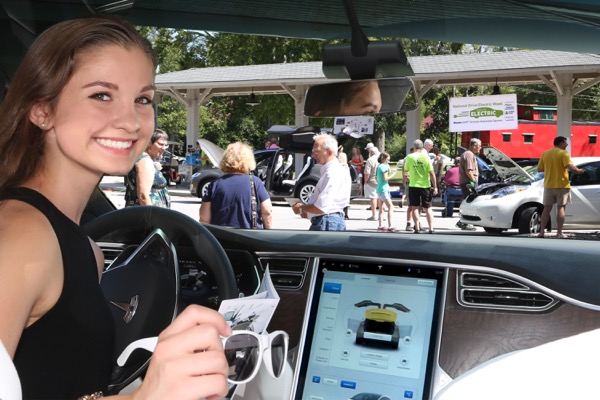
Feature Image: In Aiken, South Carolina, Cafe Scientifique Aiken’s teen board member Sydney Maddox sits behind the wheel of a Tesla Modle X. Credit: Cafe Scientifique Aiken