

The National Snow and Ice Data Center in Boulder, Co., has posted an update on the state of Arctic ice, saying that current conditions point to a bad year, but not a record-breaker.
“If the daily rate of decline this August follows the average August rate of decline for 1979 to 2000, the daily sea ice minimum in September would be 5.00 million square kilometers (1.93 million square miles), considerably higher than the record minimum of 4.13 million square kilometers (1.59 million square miles) observed for September 16, 2007.”
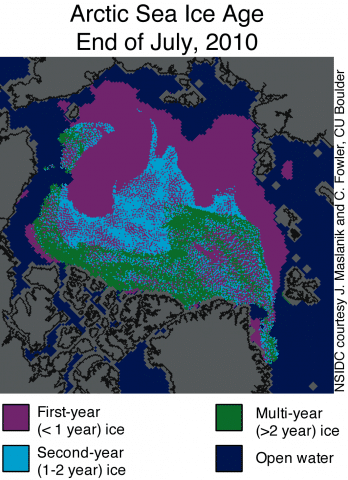
But if you look at the current graph, the ice is NOT following “the average August rate of decline.” And if you look closely at the inset illustration showing the distribution of multi-year ice, and then read the NSIDC analysis under the heading, “Older, thicker ice melting in the southern Beaufort Sea,” you will see the threat of long-term ice collapse.
The illustration shows a significant sprinkling of old ice that has been distributed into highly exposed and relatively warm areas of the Beaufort and Chukchi seas. That ice is likely to melt in the coming weeks, reducing the gross amount of resilient old ice and making the entire ice cover more fragile in coming years.
For those of you who haven’t discovered it already, the NSIDC link above will take you to a graph that is updated daily – providing an interesting, if slightly unsettling stop for anyone interested in indicators of the state of the climate.