
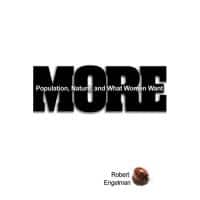
After virtually abandoning the issue for three decades, the environmental movement got a bold reality check this week from a new book highlighting relentless human population growth as a driving force behind global warming.
This wouldn’t have raised eyebrows in the 1970s, when the modern environmental movement had its genesis and Paul Erlich’s “The Population Bomb” was on just about everybody’s bookshelf. Since then, however, overpopulation has dropped from the vocabulary of most environmentalists despite a near doubling of the world’s numbers to an estimated 6.8 billion people today.
Now, a book by Worldwatch Institute vice-president Robert Engelman argues not only that it gets harder to curb greenhouse emissions as the global population increases, but also that human growth is a major factor in greenhouse emissions.
Engelman notes, furthermore, that we can’t grow forever, and if we can’t curb carbon emissions in a world of 6.8 billion, it will be impossible when there are 9 billion.
“You really can’t talk about the supply and demand imbalance that is sending energy and food prices up without acknowledging that we are adding 78 million people each year, the equivalent of a new Idaho every week,” says Engleman.
In “More: Population, Nature and What Women Want,” Engelman suggests the surest route to achieving an environmentally sustainable population is to enable women everywhere to choose when to bear children.
A former reporter who worked in population and family-planning before joining Worldwatch in 2007, Engleman interviewed women in Africa, Asia, and Latin America over a 25-year period.
Weaving their stories with research in history and the social sciences, Engleman studies sexuality and procreation to illustrate how women’s lives and status have influenced modern society.
His conclusion: The key to limiting population growth is to give control over procreation to women. Even in countries and societies where large families have always been the norm, when women take control over family size, birth rates shrink.
For the U.S., the best option is vigorous foreign aid that helps make contraception safe, reliable and accessible in every country — too often women in the developing world who want to use contraception, can’t get it. Beyond that, government doesn’t need to get involved.
“They don’t have to be coerced,” says Engelman. “This will happen as long as women are in charge.
“It makes sense that those who bear children and do most of the work in raising them should have the final say in when, and when not, to do so.
“It’s not just feminism to support population control — it’s environmentalism.”
Sadly, Engelman may have spotlighted the fatal flaw in his argument with the phrase “it makes sense.”