
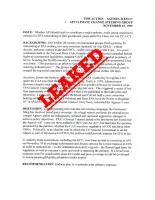
A memo exclusively leaked to the DeSmogBlog demostrates how completely the U.S. Supreme Court decision forcing the Environmental Protection Agency (EPA) to regulate greenhouse gas emissions is a repudiation of the Bush administration’s position.
White House policy on climate change and GHG emissions was revealed, most embarrassingly, by one Phil A. Cooney, a lobbyist with the American Petroleum Institute (API). President George W. Bush had hired Cooney as chief of staff of the White House Council on Environmental Quality, from which position Cooney rewrote a host of scientific reports, editing out references to the threats of climate change, regardless that he had no scientific basis or background on which to do so. When he got caught in June 2005 (thanks to Rick Piltz ), Cooney resigned and slipped quietly into a better-paying job at ExxonMobil.
The attached memo shows that as early as 1999, Cooney was leading the campaign to prevent the EPA from regulating CO2 and three other GHGs. It was Cooney’s goal as chief API lobbyist to demonstrate “industry’s unity and resolve” in opposing any EPA action.
Regardless of the court decision last week, Cooney probably feels a sense of pride: he and his fellow lobbyists succeeded for at least eight years in keeping the U.S. from making substantive improvements in national energy consumption. Of course, the damage to the environment – and to America’s international reputation – could be significant and lasting, but at least we haven’t disrupted Exxon’s profit potential.
Attached Documents
| File | Size |
|---|---|
| API CO2 petition response.pdf | 375 KB |