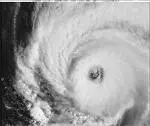
New evidence finds global warming triggers stronger Atlantic hurricanes

authordefault
onFeb 28, 2007 @ 10:00 PST

Scientists at University of Wisconsin-Madison and the National Climatic Data Center (NCDC) of the National Oceanic and Atmospheric Administration reported the finding in the journal Geophysical Researchย Letters.

โ€œThe debate is not about scientific methods, but instead centers around the quality of hurricane data,โ€ says lead author James Kossin, a research scientist at UW-Madison’s Cooperative Institute for Meteorological Satellite Studies. Kossin and his colleagues had to smooth out the data before exploring interplay between warmer temperatures and hurricane activity, essentially simplifying newer satellite information to align it with olderย records.

Sea-surface temperatures may be why greenhouse gases are exacting a unique toll on the Atlantic Ocean, says Kossin. Hurricanes need temperatures of around 27 degrees Celsius (81 degrees Fahrenheit) to gather steam. On average, the Atlantic’s surface is slightly colder than that but other oceans, such as the Western Pacific, are naturally muchย warmer.

authordefault
Admin's short bio, lorem ipsum dolor sit amet consectetur adipisicing elit. Voluptate maxime officiis sed aliquam! Lorem ipsum dolor sit amet consectetur adipisicing elit.

Related Posts

onNov 28, 2025 @ 03:02 PST

The Labour peer called for new coal power in the Global Warming Policy Foundationโ€™s annual lecture.

The Labour peer called for new coal power in the Global Warming Policy Foundationโ€™s annual lecture.
Opinion
onNov 27, 2025 @ 06:38 PST

Blunt communication is our firewall.

Blunt communication is our firewall.
onNov 25, 2025 @ 22:00 PST

The programme is โ€œyet another bung to industrial productionโ€, experts say.

The programme is โ€œyet another bung to industrial productionโ€, experts say.
Analysis
onNov 24, 2025 @ 09:00 PST

Critics say new LNG ventures in British Columbia saddle Indigenous communities with debt, opaque ownership structures, and financial risk that could leave them owing billions.

Critics say new LNG ventures in British Columbia saddle Indigenous communities with debt, opaque ownership structures, and financial risk that could leave them owing billions.